
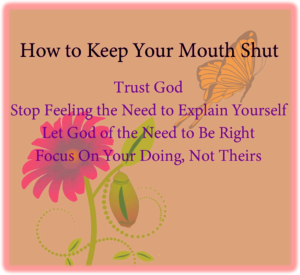
Learning To Keep My Mouth Shut… Hello readers. I suspect you are already laughing at today’s devotion and that’s OK, because I am, too. Why? Because it’s so easy to open our mouth and forget what shouldn’t come out of it! In these contentious times, it’s hard not to speak up when a person says something that is down-right wrong—a false-hood, etc. Should we react or just let it blow over?
In Psalm 39:1-5 from the Easy English Bible, David wrote a song for the leader of the music: “Life is short I said, ‘I will be careful what I do so that I do not sin. I will also be careful what I say. When wicked people are listening, I will not even open my mouth.’ So I did not speak a word, even about good things. That made me very upset. It was like a fire inside me! As I thought more about it, I just had to say something! So I said this: ‘Lord, tell me about my life. Tell me how long it will be, and when it will finish. I need to remember that life is only short. Yes, you have made the days of my life only a few! The time that I live seems very short to you. Human life is only a breath, even for those who seem to be strong. Selah.”
No doubt we try to learn to keep our mouths shut but honestly, it’s a really hard discipline, especially when the words someone said were truly wrong! Sometimes we can be one of those blustery, loudmouth extrovert person not realizing that the words that spilled out of our mouths were angry and maybe we were wrong? What a quandary indeed.
In the movie My Fair Lady, the husband’s name was Henry Higgins (played by Rex Harrison) who just wanted to be a quiet man—but his wife was anything but quiet! She could stir something up in no time—suffice it to say she never shut up! Henry just wanted the house to be as quiet “as an undiscovered tomb!” Alas that never happened.
How about you, I know for me it’s hard to bite my tongue when someone says something that’s not true. I remember my time in seminary when a college student in our Proverbs class said something that was doctrinally wrong and we all knew it. It took me all that I could to not jump up and set him straight. However, the professor did! At first, he was quite riled up but then he said quietly, “I can see why you might think that, but what would you do with verse 3 in chapter 4? Does that shed any light?” All of us were truly surprised because this professor is usually quite a stickler. But I think he was also given each of us that day to learn how we could stop a lie and turn something into good.
Did you know that “Jesus used more than three hundred questions in the Gospels?” And guess what, Jesus knew the answer to all of them! Of course, that is Jesus, he can do anything and that’s true but listen to this: ”Why did Jesus do this? Because he wanted people to experience the joy of learning something for themselves. What a great approach!”
So, how can we take that approach with others when we are in conversations that start to get heated and the lies are flying? Perhaps we should use the words from my professor who said “I can see why you might think that, but what would you do with verse 3 in chapter 4? Does that shed any light?”
In closing, let’s try to learn to “ask, not tell.” I know it’s hard when a lie is not true, but giving it up to Jesus will give us the wisdom to know when to speak and when to be still. In those moments of squabble, take a deep breath and silently say: “O Jesus, I need you right now, thank you.” AMEN.




Leave A Comment
You must be logged in to post a comment.